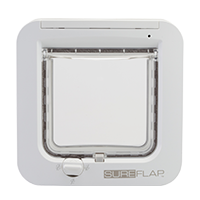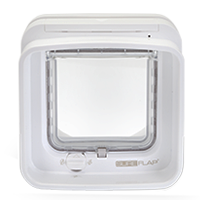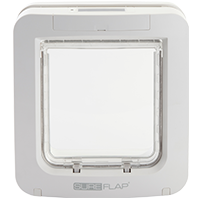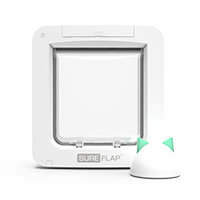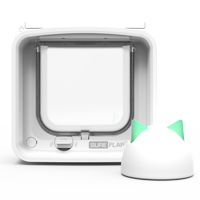

If you have a question about any of our products, installing your SureFlap or microchipping your cat, take a look at the frequently asked questions below.
If you cannot find the answer to your question, please feel free to contact us and one of our customer service team will be able to assist you.
A microchip is a tiny implant about the size of a grain of rice. In a painless procedure, your vet injects this under the skin of your cat, between the shoulder blades. Your cat now has a permanent ID without the worry of a collar or tag becoming detached.
The microchip is computer readable and lasts indefinitely as it doesn't need a battery to operate. Each microchip has a unique ID number that can be put onto the microchip manufacturer's registration database together with your address details. The SureFlap Microchip Cat Door is compatible with the most common types of microchips used in cats. Specifically the SureFlap Microchip Cat Door works with the following types of microchip:
10-digit microchips* (also known as FDXA, most commonly used in the USA)
15-digit microchips (also known as FDXB, standard in Europe)
9-digit microchips (also known as Avid Secure/Encrypted Chip)
If your cat becomes lost, all vets and re-homing centers are equipped with a special scanner to read its microchip. They can look up the ID number to find the manufacturer of the microchip. The manufacturer can then provide your contact details in order to reunite you with your pet.
*Except those with codes starting 000..., 010..., 020...
Microchips don't contain a battery and therefore have an indefinite lifetime. The special scanner required to read the microchip supplies the tiny amount of power it needs each time it is read.
Also, there is no limit to the number of times that the microchip can be read. It should continue running at least as long as your cat!
Microchips can occasionally fail, meaning that they can no longer be read by your SureFlap Microchip Cat Door. If you suspect that your cat's chip may have stopped working, take your cat to the vet where they will be able to check for the presence of your cat's chip using a hand-held scanner.
Yes. The SureFlap Microchip Cat Door is compatible with the following types of identification microchip commonly used for pets:
10-digit microchips* (also known as FDXA, most commonly used in the USA)
15-digit microchips (also known as FDXB, standard in Europe)
9-digit microchips (also known as Avid Secure/Encrypted Chip)
In order to ensure operation with your cat we do advise testing BEFORE installation.
*Except those with codes starting 000..., 010..., 020...
When the SureFlap Microchip Cat Door is put into learn mode, the door unlocks automatically. The cat door reads the microchip of the next cat to go through the flap and its unique ID number is stored in the memory permanently. Your cat will now be recognized by the cat door.
Using this learn mode you don't have to force an uncooperative cat through the flap. Just leave the microchip cat door in learn mode and let him go through in his own good time. Simply repeat this process with multiple cats.
No. Each microchip has a unique ID number, so intruder cats have no chance of making it through the door.
Your vet will be able to do this for you. The procedure is a quick, painless injection of the microchip between the shoulder blades of your cat. It usually costs around $30-50 to get your cat microchipped. A small additional fee may apply to register your details on the manufacturer's database.
Unlike most other selective entry cat doors, SureFlap reads the unique number of your cat's microchip to grant access for your cat. This means that your cat does not need to wear an uncomfortable and restrictive collar, which can easily become snagged on objects or lost altogether, leaving your cat stuck outside.
SureFlap is the first multi-format microchip cat door, so you don't need to worry about which type of microchip your cat has, as SureFlap is compatible with all of the microchip types commonly used in cats.*
The SureFlap Microchip Cat Door is the only cat flap to use patented low power Radio Frequency Identification (RFID) technology which enables it to run exclusively on batteries. SureFlap has been designed to scan for a cat's microchip only when it detects a cat's head in the tunnel, thereby saving power. For this reason typical battery life is up to 12 months with normal use.
The SureFlap Microchip Cat Door fits into the slots left by most existing cat doors and its simple two-part construction makes it very quick and easy to install.
* Except those with codes beginning 000..., 010..., 020...
SureFlap currently only manufactures microchip cat doors. However, we are currently working on a larger version of the SureFlap Microchip Cat Door that will be suitable for small dogs. This should be available in early 2012.
If we make a dog door in the future that is suitable for different sizes of dogs we will display it on our website.
Yes, the SureFlap Microchip Cat Door can remember up to 32 different cats at the same time - more than enough for most people's lifetime!
Even if you exceed the limit of 32 cats, the oldest codes are replaced first. There is also the option to wipe the memory if you mistakenly program in the wrong cat.
Yes, once a cat's microchip number is stored it stays in the memory whether the batteries are in place or not.
The SureFlap Microchip Cat Door stops unwanted visitors coming into your house. In normal mode, any animal inside is able to leave the house.
You can use the 4-way manual lock to stop any animal entering and/or leaving the house, but you cannot do this selectively for different cats.
We have had a number of customers using the SureFlap Microchip Cat Door in conjunction with an invisible fence with no problems reported.
Yes, cats wearing collars (metallic or not) can use the SureFlap Microchip Cat Door without any problems.
Dimensions of the SureFlap, including the smallest area that your cat will need to pass through, can be found here.
Full mounting instructions are provided in the user manual. You can also download the installation template which you can use to cut the hole required to install a SureFlap Microchip Cat Door.
The easiest solution is to use the SureFlap mounting adaptor. This adaptor extends the area of the cat door to cover larger hole sizes (up to 10
Installation in most door types is straight forward; however, in very rare instances it may be necessary to use an oversize hole to mount SureFlap in a metal door. Further details are provided on page 8 of the user manual.
Full installation instructions for all door types are given on page 7 of the user manual.
SureFlap is ideal for mounting in single, double-paned or even triple-paned doors and windows. If you need to have a hole cut in a window, please ask a qualified glazier to do it, as cutting glass is a skilled job. If you need to get a hole cut in your window the ideal size is 8.5 in diameter. A mounting adaptor is available to complete an installation in glass, and is suitable for covering holes from 8.5 to 10.25 in diameter.
You can view our glass installation video and download step-by-step glass installation instructions here. Alternatively full installation instructions are included in the user manual.
We recommend using the SureFlap mounting adaptor and tunnel extender accessories to mount SureFlap in a wall.
Full wall mounting instructions can be found on pages 9 and 10 of the user manual.
The SureFlap Microchip Cat Door operates using 4 AA (1.5V) batteries. We recommend the use
of good quality, alkaline batteries in order to give the longest lifetime.
We do not recommend the use of rechargeable batteries unless they are RAMcellTM alkaline rechargeable batteries. You can buy RAMcell alkaline rechargeable batteries here.
With normal usage, one set of batteries will typically last for up to 12 months. The low battery indicator tells you when the batteries need changing.
The sensor that detects the presence of a cat in the tunnel is optical and is situated on the inside roof of the tunnel, close to the flap. If these lenses become obscured by dirt then unreliable operation and/or shortened battery lifetime may result. Wipe these lenses regularly with a damp cloth.
Operation of the sensor relies on a reflection from the base of the tunnel, which should also be kept reasonably clean.
After cleaning, wait for approximately 10 seconds for the unit to retun to normal operation.
View our cleaning video